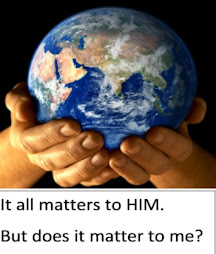
Fair. Put one piece of cake on the table in between 2 kids and you'll get an immediate lesson in fair. (For those of you with kids, I've heard the way of making sure things are fair in this situation is to let one child cut the piece of cake and the other get first dibs on which half they want!) Kids are keenly aware of fair. But then, most adults I know are pretty aware too!
I came across this book last night. It had the title that went something like "Fair Isn't Always Equal." Maybe it stood out to me because "fair" was on my mind. Like most people, I like things to be fair. If they aren't fair, I prefer to be in the one up position. Honestly, (like most people, I think) I probably don't even think about fair unless I feel like I'm getting the short end of the stick.
When I was on staff with InterVarsity Christian Fellowship, our Regional staff meetings one year were on Racial Reconciliation. They had a variety of activities they put us through and then debriefed. One was a race with candy as the reward. We started out in one line. Then the facilitator said something like, "If you were raised in a two parent home, take one step forward. If you had a library card growing up, take a step forward. If you had a computer at all in your home, take a step forward." After several of those, we also heard, "If you spent time in a foster home, take a step back. If you have ever been refused service somewhere, take a step back." You get the picture.
While we all believed in equality, the game showed us an enormous amount of situations where things weren't fair. In the end, a couple staff were way out ahead and none of the rest of us had a chance. One staff member was actually behind the line where we had all begun. Most had the sensitivity to be embarrassed at being so far ahead. It was humbling.
I don't know anything about that book, so I cannot recommend it. But I do think it is true. Fair isn't always equal.
As I've thought about it, I've also come to realize that God is more concerned about my character than about fair. I don't know where that thought came from. Maybe God whispered it in my ear or tugged it out of some recess of my mind from long ago. Where ever it came from, I think it is an amazing thought and it sets my priorities on end. I am so much more likely to think about fair before my character.
How do I know God is more concerned about character than fair? Look at the cross. The cross is stands in stark contrast to fair. There was nothing fair about Jesus death on the cross. If Jesus was concerned about fair, I would have been nailed to the cross for my sins instead of Jesus.
There is no mercy in fair. There is no grace in fair. Rather fair is about what is deserved or earned. Mercy is about not getting what we deserve. Grace is mercy's kindred spirit but takes it one step further and offers what we do not deserve and can never earn.
Fair is rigid. Mercy and grace are fluid and in God's love, they wrap themselves around His children.
Fair has it's merits. Merit is it's cornerstone. But stone is cold. I'll choose mercy and grace.
The challenge now learning let go of fair in relation to those around me and offer mercy and grace instead.
While I'm praying that, it's scary. Choosing those things are hard. God used that book title to remind me. Even last night, I found the words, "That's not fair" coming quickly to mind. Mercy and grace. Mercy and grace. Pray that I remember those words before fair even creeps in.
Thank God that He cares more about my character, about me, than He does about honoring my sense of fair.
Wednesday, July 8, 2009
Fair Isn't Always Equal
Saturday, April 4, 2009
Two Choices
A friend forwarded the following story to me. These are not my thoughts and I'm not sure where it originated. I thought it worth sharing with all of you.
At a fundraising dinner fo a school that serves children with learning disabilities, the father of one of the students delivered a speech that would never be forgotten by all who attended. After extolling the school and its staff, he offered a question:
"When not interfered with by outside influences, everything nature does, is done with perfection. Yet my son, Shay, cannot learn things as other children do. He cannot understand things as other children do. Where is the natural order of things in my son?"
The audience was stilled by the query.
The father continued.
"I believe that when a child like Shay, who was mentally and physically disabled comes into the world, an opportunity to realize true human nature presents itself, and it comes in the way other people treat that child."
Then he told the following story:
"Shay and I had walked past a park where some boys Shay knew were playing baseball. Shay asked, 'Do you think they'll let me play?'"
"I knew that most of the boys would not want someone like Shay on their team, but as a father I also understood that if my son were allowed to play, it would give him a much needed sense of belonging and some confidence to be accepted by others inspite of his handicaps . . . ."
"I approached on of the boys on the field and asked (not expecting much) if Shay could play. The boy looked around for guidance and said, 'We're losing by six runs and the game is in the eighth inning. I guess he can be on our team and we'll try to put him in to bat in the ninth inning.'"
"Shay struggled over to the team's bench and, with a borad smile, put on a team shirt. I watched with a small tear in my eye and warmth in my heart. The boys saw my joy at my son being accepted."
"In the bottom of the eighth inning, Shay's team scored a few runs but was still behind by three."
"In the top fo the ninth inning, Shay put on a glove and playd in the right field. Even though no hits came his way, he was obviously ecstatic just to be in the game and on the field, grinning from ear to ear as I waved to him from the stands.
"In the bottom of the ninth inning, Shay's team scored again.Now, with two outs and bases loaded, the potential winning run was on the base and Shay was scheduled to be next at bay. At this juncture, do they let Shay bat and give away their chance to win the game?"
"Surprisingly, Shay was given the bat."
"Everyone knew that a hit was all but impossible because Shay didn't even know how to hold the bat properly, much less connect with the ball. However, as Shay stepped up to the plate, the pitcher recognizing that the other team was putting winning aside for this moment in Sahy's life, moved in a few steps to lob the ball in softly so Shay could at least make contact."
"The first pitch came and Shay swung clumsily and missed."
"The pitcher again took a few steps forward to toss the ball softly towards Shay."
"As the pitch came in, Shay swung at the ball and hit a slow ground ball right back to the pitcher. The game would now be over. The pitcher picked up the soft grounder and could have easily thrown the ball to the first baseman. Shay would have been out and that would have been the end of the game."
"Instead, the pitcher threw the ball right over the first baseman's head, out of reach of all teammates. Everyone from the stand adn both teams started yelling, 'Shay, run to first! Run to first!'"
"Never in his life had Shay ever run that far, but he made it to first base. He scampered down the baseline, wide-eyed adn startled. Everyone yelled, 'Run to second, run to second!' Catching his breath, Shay awkwardly ran towards second, gleaming and struggling to make it to base.'"
"By the time Shay rounded towards secomd base, the right fielder had the ball. The smallest guy on thier team who had his first chace to be the hero for his tea. He could have thrown the ball to the second-baseman for the tag, but he understood the pitcher's intentions so he, too, intentionally threw the ball high and far over the third-baseman's head. Shay ran toward third base deliriously as the runner ahead of him circled the bases toward home. All were screamin, 'Shay, Shay, Shay, all the way Shay!'"
"Shay reached thrid base becuase the opposing shortstop ran to help him by turning him in the direction third base, and shouted, 'Run to third! Shay, run to third!'"
"As Shay rounded third, the boys from both teams, and the spectators, were on thier feet screamin, 'Shay, run home! Run home!'"
"Shay ran to home, stepped on the plate, and was cheered as the hero who hit the grand slam and won the game for his team."
"That day, said the father softly with tears now rolling down his face, "the boys from both teams helped bring a piece of true love and humanity into this world."
Shay didn't make it to another summer. He died that winter, having never forgotten being the hero and making me so happy and coming home and seeing his mother tearfullly embrace her little hero of the day!
A wise man once said every society is judged by how it treats it's least fortunate amongst them.
My thoughts:
I believe that wise man is right. But what if it isn't just the society that is judged by how it treats it's least fortuante amongst them. What if we are judged by how we treat those least fortunate that cross our life's path?
Where would you be in the story? What choice would you make?
Given the chance would you have let Shay play?
Would you have been willing to forfeit the game by letting Shay bat?
Would you have lobbed the ball softly or thrown it wide?
Would you have cheered Shay home?
I like to think that I would have done all of those things. Maybe on my better days I would. But on my bad days, would I make that choice? I hope so.
This month is Autism Awareness month. Autism is an odd disease. It covers a broad range of diagnoses. Some are the ones you can readily identify. The child who doesn't want to be touched and lines things up over and over and over. Some are more subtle with conversations just being strange or off. It depends on the degree of the illnesses and the diagnosis itself. You may or may not go, "Something is off."
When you recognize it, do you rise to the occassion and act with compassion?
What about when you don't? Do yo act compassionately then?
Laura Story has a song out with the song starting, "Everyone needs compassion. A love that's never failing. Let mercy fall on me."
What if we recognized that need in everyone? I wonder what our world would be.
Wednesday, July 23, 2008
When You Give Someone a Cookie
The other night I was reading Lisa Whittle's post. She always makes me think. It was about how one of her dear friends didn't like her initially. Ouch. But this woman decided to pray for her. Now, she is one of those friends that Lisa can call any time.
I had taped a show Friday night called Flashpoint. It's a new cop type show. Given that everything else is reruns, I decided to tape it. I finally got around to watching it. Here's the storyline. A man gets the page letting him know that he should rush his daughter to the hospital for a heart transplant. They get there and settled in only to find out that there was a mix up and the heart is going to someone else. The dad has been up for three days straight in a vigil over his dying daughter. The stress breaks him. He grabs a security guy's gun and takes hostages.
Of course, that is when they call in the team. I haven't watched it enough to know the names of everyone yet. But "Head Guy" goes in to negotiate with him. Others are watching him on the monitor. The dad wants the TV turned back on for his daughter. Rule #1, never give a hostage taker anything without getting something in return. So, Head Guy asks dad to ask each person if they are okay. He does this but skips the man on gurney who is slated to get the heart. Head Guy says, "What about him? Is he okay?" He encourages dad to ask him.
The rest of the team who are watching debrief this for us. It turns out that one of the tactics is to make the hostage into a person. By having dad ask the hostage if he is okay, the hostage begins to become a person rather than a means to an end.
Lisa's post fit right in with this. It made me think of work. One woman works in another office. One day when I was still very new, she came in the back door, walked to my desk, and demanded that I look something up for her. I was in the process of leaving and I was use to people going to the counter. I got really flustered and was offended by her tone. I managed to find what she needed but decided that I didn't like her at all. After she left, they explained who she was and all, but it didn't help me liking her.
A couple months ago I made my famous chocolate chip cookies. (I'm probably overly proud of them.) I took some to the office. As I was taking a short break, God prompted me to put three on a little plate and take them down to this woman. From that time forward, every time I walk by she waves. If she comes into the office, she stops to talk to me. When you give someone a cookie or a prayer or a smile, sometimes you forge a connection because you have made them human.
I've probably used this C.S. Lewis quote before, but I think it sums things up so nicely that I'll use it again.
It is a serious thing to remember that the dullest and most uninteresting person you talk to may one day be a creature which, if you saw it now, you would be strongly tempted to worship or else a horror and a corruption such as you meet, if at all, only in a nightmare. All day long, we are, in some degree, helping each other to one or the other of these destinations. It is in the light of those overwhelming possibilities, it is with the awe and the circumspection proper to them, that we should conduct all our dealing with one another, all friendships, all loves, all play, all politics. There are no ordinary people.
When we remember another's humanness, we treat them with more humanity. When we remember that they may have things going on in their lives that we know nothing about, we can respond with mercy and kindness. When we treat them with respect even when we might not feel respected, we give them dignity. When we offer kindness, we never know what doors God will open up.